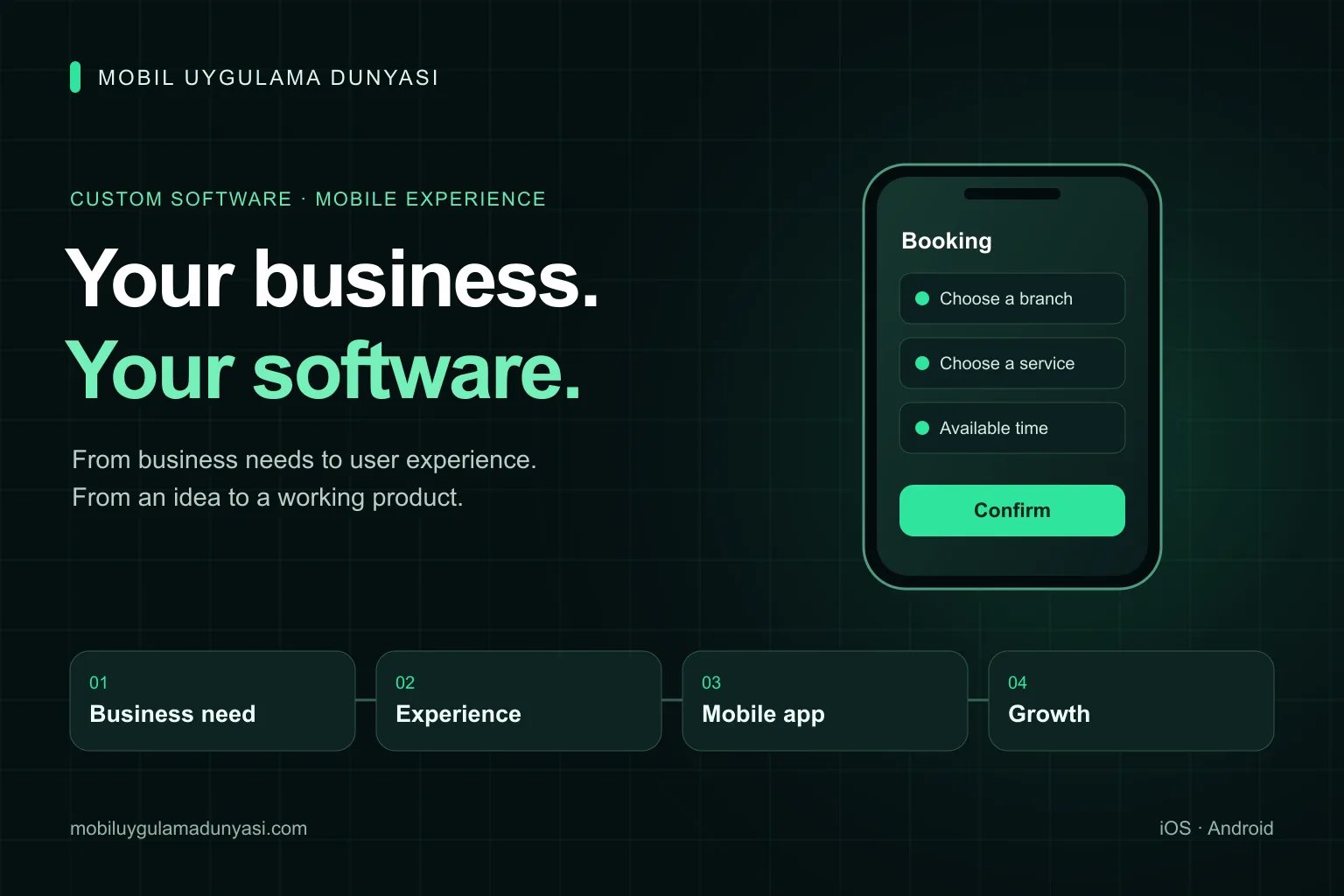
A search for the best software companies usually starts with a practical business need: helping customers finish a task, reducing repeated data entry, or making a new service available on mobile. Software creates value through how well it meets that need. At Mobil Uygulama Dunyasi, we start by understanding what you want to achieve and shaping it into a useful mobile product.
A custom software company designs screens, business rules, and data flows around the way your business needs to work. We apply that approach to iOS and Android apps, connecting product planning, UI/UX design, development, testing, and app store launch. The conversation covers both the features you need and how those features will help your customers and your team.
What business needs can a custom software company address?
A business with several branches may have its own booking rules. A field team may need a particular task workflow, while a membership service may have different access conditions. When existing tools do not support these processes, an app designed around your requirements can make sense. Our aim is to put those rules into practice without making users work through unnecessary steps.
During a discovery call, we discuss your current process, who will use the app, and which task you want to simplify. The first goal might be letting a customer find an available appointment and complete a booking, rather than changing the whole operation at once. Defining that core journey helps keep the first release focused.
Design should turn a business goal into a completed task
Can a user tell what to do when they open the app? Is it clear why a form asks for a particular detail? Can they see the outcome after submitting it? These questions shape our UI/UX work. Alongside the visual design, we plan navigation, forms, loading states, and error messages as part of the same experience.
The goal is to make your service easy to understand. In a booking flow, for example, showing the selected date, service, and branch together lets the user check their choices. Working through a flow and prototype before development gives us a practical way to discuss these decisions across connected screens.
Speed and performance belong in the development process
Fast startup matters, as do smooth scrolling, responsive search, and a clear path to completing a task. We consider performance throughout development. That includes image sizes, when data is loaded, how long lists are displayed, and how service requests affect the user experience.
We also define test scenarios around how the app will be used: different devices, slow connections, empty results, service failures, and simultaneous requests. A fast-looking demo does not show every one of these conditions. We aim to identify suitable measurements for the project and find opportunities to improve core journeys such as startup, search, and booking.
A practical example: a booking app for a business with branches
Consider a business that manages bookings through calls and messages. A customer asks for an available time, the team checks a calendar, and someone sends a separate confirmation. A mobile flow we could design would connect branch and service selection, current availability, and the booking outcome in one experience.
| Business need | Flow to address in the app |
|---|---|
| Help customers find the right service | Present branches, services, and available times clearly. |
| Prevent two bookings for the same slot | Validate availability and save the booking as one operation on the server. |
| Make the outcome clear | Show confirmation status, a booking summary, and a suitable notification flow. |
| Keep track of changes | Handle cancellations or rescheduling according to the business rules. |
If this resembles your requirements, explore our booking and reservation solutions and discuss how your own process could work in an app.
How does development work with Mobil Uygulama Dunyasi?
We build the development plan around your business goal and the first experience you want to offer users. Feature and technology decisions follow that plan. We assess native iOS, Android, Flutter, or React Native against the technical requirements of your project.
- Understand the need: Define the users, the main task, and the difficulty in your current process together.
- Plan the first release: Identify the essential flows, integrations, and work that can follow in later releases.
- Design the experience: Shape the user journey, prototype, and visual design around the same product goal.
- Develop and test: Work through the app, its service connections, and failure scenarios together.
- Launch and continue: Discuss app store launch, maintenance needs, and later releases within the project's scope.
How do we plan for growth and integrations?
A service that starts with one branch may later add locations or membership types. Discussing these possibilities early helps us make informed decisions about data and access permissions. We plan a scope that meets your current need and provides a suitable foundation for later steps, without putting every possible feature into the first release.
If the app needs to connect to payments, inventory, or existing business systems, we treat those integrations as part of the product journey. The plan covers which system holds each piece of information, who can perform each action, and what the user sees if a connection fails. We assess security and access decisions against the data being handled and the roles of the people using the app.
Let's shape a mobile solution around your business
Explore our mobile app solutions for journeys ranging from commerce and bookings to field operations and membership services. If your process does not fit a standard category, we can discuss your project through our custom workflow approach.
Turning your search for the best software company into a practical project conversation does not require a lengthy technical document. Start by telling us who you serve, which task you want to simplify, and how the process works today. In a free discovery call with Mobil Uygulama Dunyasi, we can discuss the first release, technical requirements, timeline, and budget range together.
Planning a custom mobile app for your business? Share your idea and let's discuss the user experience, performance, and development scope together.